Worked tutorial
Shrink noisy effect estimates
Start with an estimate and its standard error for each effect. This example uses eight fixed illustrative inputs from the reference manual.
from ashrink import fit

result = fit(
    [-1.4, -0.6, -0.1, 0.0, 0.2, 0.7, 1.8, 2.2],
    [0.7, 0.4, 0.5, 0.3, 0.5, 0.4, 0.8, 0.7],
    scales=[0.2, 0.6, 1.5],
)
print(result.format_summary())
intervals = result.interval(level=0.95)
scales gives the fixed standard deviations of the normal-prior components.
The fit estimates their mixture weights. The first three posterior means are
[-0.764278, -0.306851, -0.032956].
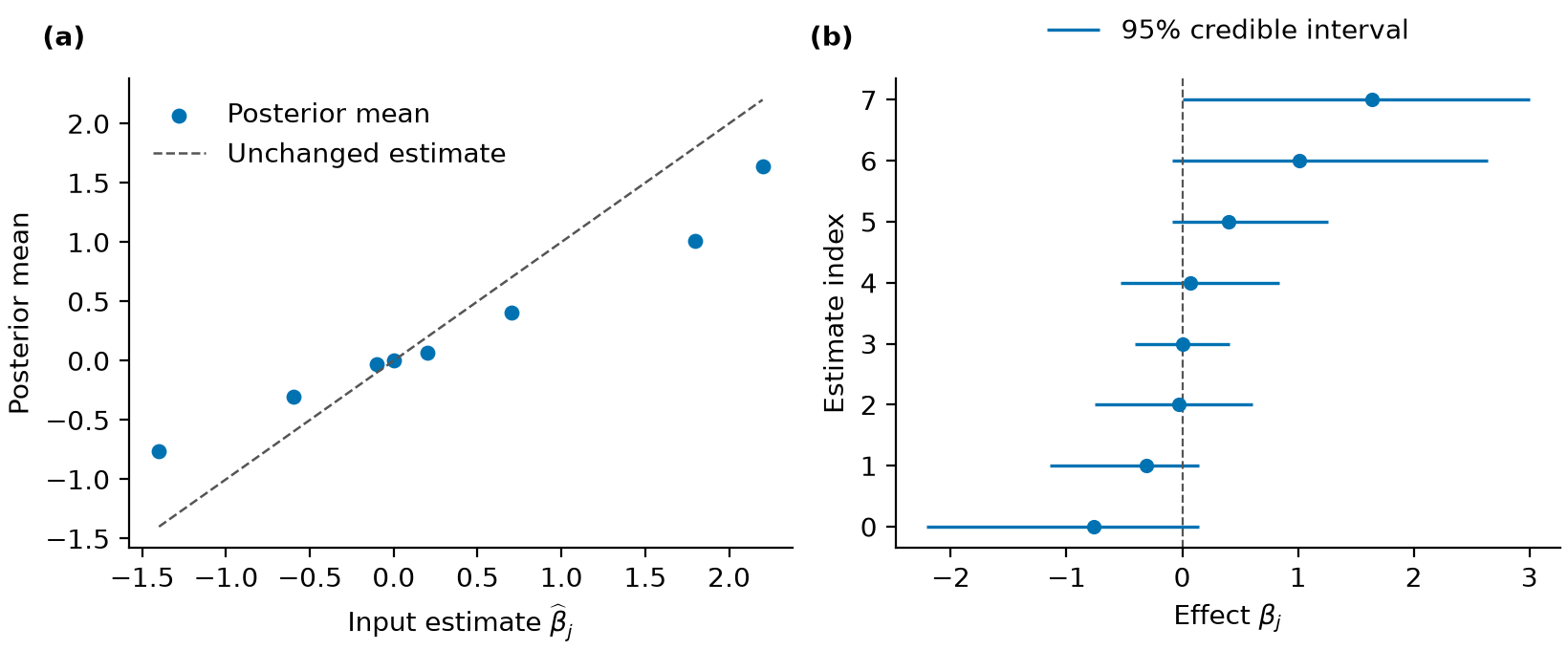
The left panel compares input estimates with posterior means. The right panel shows equal-tailed 95% credible intervals, conditional on the fitted prior. The displayed values are available as CSV. These intervals omit uncertainty from estimating the mixture weights.
Inspect and save the result
Use result.summary() for numeric reporting columns and
result.format_summary() for compact text. result.posterior_sd reports posterior
standard deviations. The API guide explains null and sign probabilities,
including their interpretation when the prior has a point mass at zero.
save_result and load_result write and restore versioned JSON results.
Saved files retain input data and should be handled with the same care as those
inputs. The manual gives the complete saving example.
Analyze other inputs
The manual has worked examples for Student-t estimates, count data and effects across conditions. Student-t inputs require scale parameters, which differ from their standard deviations. Count models return rates or probabilities on their respective parameter scales.
For continuous, binary, count or grouped outcomes with predictors, follow the regression guide. Its predictions return outcome means; they do not include future observation noise or prediction intervals. The repository also contains the fixed summary-input examples and regression extensions.